
Accounting Firm Cyberattacks: Why Tax Season Is Prime Time for Cybercriminals
Tax season is prime time for cyberattacks targeting accounting firms. Learn how Harp's 24/7 SOC, EDR, and ITDR help protect sensitive financial data.
By Jim Ryan, Founder & Chairman, Harp Cybersecurity
01
Tax Season Isn't Just Busy for Accountants
For accounting firms, tax season is the busiest time of the year. Phones are ringing, client documents are arriving, deadlines are approaching, and teams are working long hours to keep everything on track.
Unfortunately, it's also one of the busiest times of the year for cybercriminals. While accountants are focused on helping clients meet filing deadlines, attackers are looking for opportunities to exploit distracted employees, overloaded inboxes, and the increased flow of sensitive financial information.
This isn't a coincidence. It's a strategy. Accounting firms manage some of the most valuable information a cybercriminal can obtain, making tax season one of the most attractive opportunities for cyberattacks.
02
What Recent Tax Season Cyberattacks Tell Us
Publicly reported cybersecurity incidents during recent tax seasons demonstrate a growing trend: accounting firms are increasingly being targeted by ransomware, phishing campaigns, Business Email Compromise (BEC), and credential theft.
According to public reporting, attackers have sought access to highly sensitive information, including Social Security numbers, tax returns, payroll records, IRS authorization forms, financial statements, invoices, and internal business communications.
While every incident differs in scope and outcome, the broader pattern is becoming increasingly clear. Accounting firms of every size have become attractive targets because they manage large volumes of highly sensitive financial and personal information while operating under intense seasonal deadlines.
03
The Real Business Impact of a Cyberattack
Whether an accounting firm has ten employees or several hundred, it is responsible for safeguarding highly confidential client information. That includes tax returns, payroll records, banking information, financial statements, corporate filings, and other sensitive business data.
Unlike many other industries, attackers don't always need to encrypt systems to profit. Simply stealing confidential information may be enough to monetize an attack. In other cases, ransomware deployed during tax season creates operational pressure that can significantly disrupt client service.
The consequences extend well beyond recovering systems. Client confidence is challenged. Regulatory obligations may follow. Critical deadlines become more difficult to meet. Business operations slow during the firm's busiest time of year.
Today's accounting firms also face a broader range of threats than ransomware alone. Business Email Compromise (BEC), Microsoft 365 account takeovers, phishing campaigns, wire fraud, invoice fraud, and identity-based attacks have all become increasingly common. Most successful attacks don't begin with sophisticated malware. They begin with something much simpler: a phishing email, a stolen password, a compromised Microsoft 365 account, or an employee making a quick decision under deadline pressure.
04
Why Visibility Matters More Than Ever
One question we frequently hear from accounting firms is: "We already have antivirus and firewalls. Isn't that enough?" Those tools remain important, but they don't always answer the questions that matter most.
- Has a Microsoft 365 account been compromised?
- Is someone logging in from an unusual location?
- Has an employee account started accessing files it normally wouldn't?
- Would anyone know before confidential client information is exposed?
05
Practical Steps to Strengthen Cybersecurity Before Tax Season
No accounting firm can eliminate cyber risk entirely, but every organization can take practical steps to strengthen its security posture.
- Enable Multi-Factor Authentication (MFA) across all employee accounts
- Continuously monitor Microsoft 365 identities and login activity
- Verify banking changes and wire transfer requests through a secondary communication channel
- Train employees to recognize phishing emails and Business Email Compromise attempts
- Review user access to confidential client information regularly
- Continuously monitor endpoints for suspicious activity
- Develop and routinely test an incident response plan before it's needed
06
How Harp Cybersecurity Helps Accounting Firms
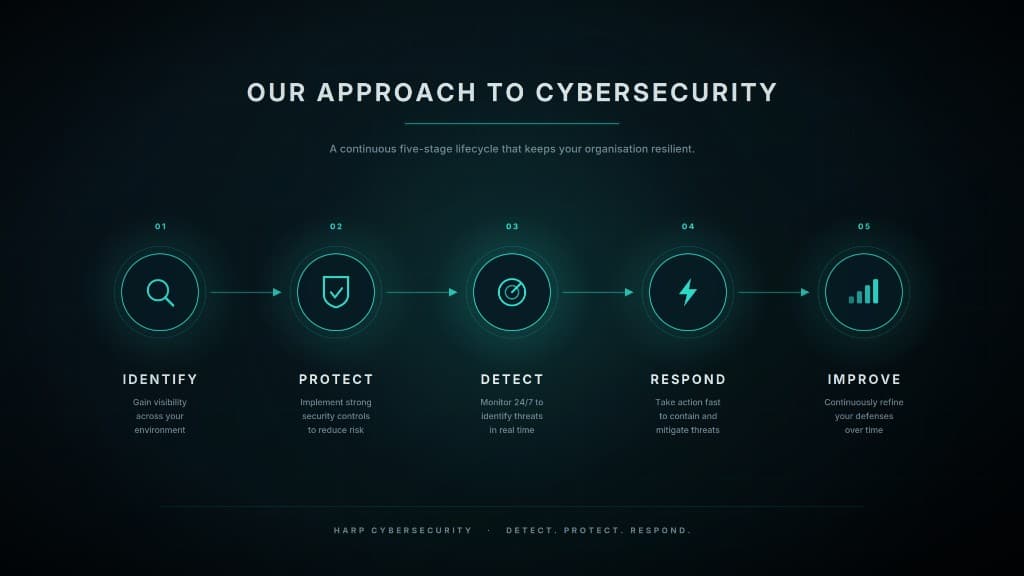
Accounting firms don't need an enterprise-sized security team to improve their cybersecurity posture. Harp delivers Cybersecurity as a Service built around four core capabilities:
- Managed Endpoint Detection & Response (EDR)
- Managed Identity Threat Detection & Response (ITDR)
- Security Information & Event Management (SIEM)
- 24/7 Security Operations Center (SOC)
07
Final Thoughts
Tax season places extraordinary demands on accounting firms. Unfortunately, cybercriminals understand that busy organizations are often more vulnerable because employees are processing large volumes of sensitive information while working under tight deadlines.
The firms that recover most effectively aren't necessarily those with the largest IT departments. They're the ones that have the visibility to detect suspicious activity early, respond quickly, and minimize disruption before an incident affects clients or operations.
For accounting leaders, the question is no longer whether cybersecurity should be a priority. The question is: how quickly would you know if suspicious activity was occurring inside your environment today? Ready to strengthen your firm's security posture? Contact Harp Cybersecurity to learn how our Managed EDR, ITDR, SIEM, and 24/7 SOC services help accounting firms stay protected throughout tax season and beyond.