
One Click Is All It Takes: Why Human Error Is Still a Small Business's Biggest Cybersecurity Risk
Learn how phishing, credential theft, and everyday human error can expose small businesses to cyber risk, and how layered security helps reduce the impact.
By Jim Ryan, Founder & Chairman, Harp Cybersecurity
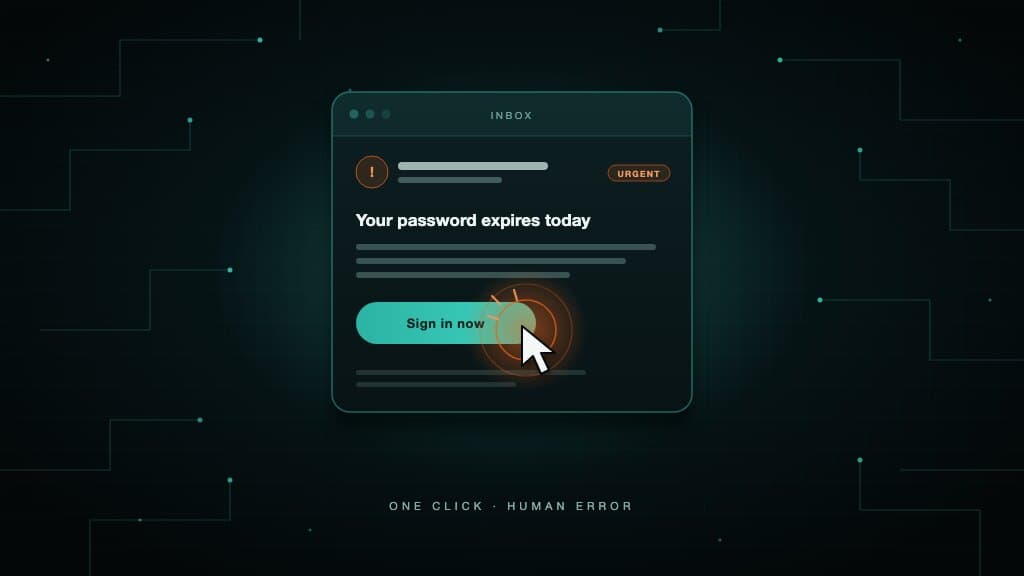
Cybersecurity threats do not always begin with sophisticated hackers breaking through complex systems. Sometimes, all it takes is one employee clicking the wrong link.
For small and midsize businesses, human error remains one of the most important cybersecurity risks to manage. Employees interact with email, cloud applications, customer information, passwords, financial systems, and company devices every day. Each interaction creates an opportunity for attackers to target the person behind the technology rather than the technology itself.
And as cybercriminals adopt more convincing phishing techniques and AI-generated content, recognizing those threats is becoming increasingly difficult.
01
The Human Side of Cybersecurity
Businesses often focus their cybersecurity investments on technology: firewalls, antivirus software, endpoint protection, and other security tools.
Those protections matter, but technology alone cannot eliminate risk.
An employee may unknowingly:
- Click a link in a convincing phishing email.
- Open a malicious attachment.
- Reuse the same password across multiple accounts.
- Enter credentials into a fake login page.
- Approve an unexpected multifactor authentication request.
- Send sensitive information to someone impersonating a customer, executive, or vendor.
Attackers understand this. Instead of attempting to defeat security systems directly, they frequently use social engineering to convince someone inside the organization to give them access.
02
Phishing Is Getting Harder to Spot
Traditional phishing emails were often relatively easy to identify. Misspelled words, unusual formatting, suspicious email addresses, and poorly written messages were common warning signs.
That is changing.
Generative AI can help attackers produce polished, professional-looking messages in seconds. A fraudulent email can imitate the tone of a legitimate business communication and create a convincing sense of urgency.
An employee might receive what appears to be a routine request:
"Your Microsoft 365 password expires today. Sign in here to maintain access."
The page may look legitimate. The message may sound professional. But entering credentials could hand an attacker exactly what they need.
One click can become the beginning of a much larger incident.
03
Small Businesses Can Be Attractive Targets
Cybercriminals do not exclusively target large corporations.
Small businesses may hold valuable customer information, payment information, employee records, business credentials, and access to third-party systems. At the same time, smaller organizations may have limited cybersecurity resources or lack dedicated security personnel.
That combination can create opportunities for attackers.
A successful compromise can result in operational disruption, compromised accounts, data exposure, financial losses, reputational damage, and significant time spent recovering systems and investigating what happened.
For a small business, even a relatively contained incident can become expensive.
04
Reducing Human Error Starts With the Basics
Businesses do not need to eliminate every possible human mistake. That is unrealistic.
Instead, cybersecurity should be designed so that a single mistake is less likely to become a major incident.
Several fundamental practices can significantly strengthen that defense.
Train employees regularly. Cybersecurity awareness should not be limited to an annual presentation. Employees should understand phishing, social engineering, suspicious attachments, credential theft, and how to report something that does not look right.
Use multifactor authentication. A stolen password should not automatically provide access to a business account. MFA adds another layer of protection when credentials are compromised.
Strengthen password practices. Encourage unique passwords and consider password-management solutions that reduce password reuse.
Protect endpoints. Company laptops and other devices should have appropriate security controls, monitoring, updates, and protection against malicious activity.
Keep systems updated. Attackers frequently look for known vulnerabilities in outdated software. Maintaining current security patches reduces unnecessary exposure.
Create a simple reporting process. Employees should know exactly what to do if they click something suspicious. Rapid reporting can give the organization valuable time to investigate and contain an incident.
05
Build Security Around People, Not Just Technology
The objective of cybersecurity should not be to expect employees to recognize every threat perfectly.
It should be to create layers of protection.
Training helps employees identify suspicious behavior. Strong authentication makes stolen credentials less useful. Endpoint security helps detect malicious activity. Monitoring can identify unusual behavior. Incident-response procedures help organizations react quickly when something goes wrong.
Together, these layers create a more resilient business.
Because eventually, someone may click the wrong link.
The question is whether that click becomes a minor security event or a major business problem.
06
How Harp Cybersecurity Helps Reduce Human-Driven Risk
Employee awareness is an important layer of defense, but businesses should not have to rely on employees recognizing every threat.
Harp Cybersecurity helps small and midsize organizations build additional layers of protection around their people through managed cybersecurity capabilities, including Endpoint Detection & Response (EDR), Identity Threat Detection & Response (ITDR), Security Information & Event Management (SIEM), 24/7 Security Operations Center (SOC) monitoring, and Vulnerability Assessments.
Together, these capabilities help organizations identify suspicious endpoint behavior, detect compromised identities, improve visibility across their environment, and respond more quickly when something goes wrong.
The goal is not to eliminate human error. It is to make sure one mistake does not become a business-wide incident.
07
Final Thoughts
One click may be all it takes to start an attack. Make sure one click isn't all it takes to compromise your business.
Protect your business before the next threat reaches your inbox.
Learn more about Harp Cybersecurity and explore the cybersecurity protection available for your business.